
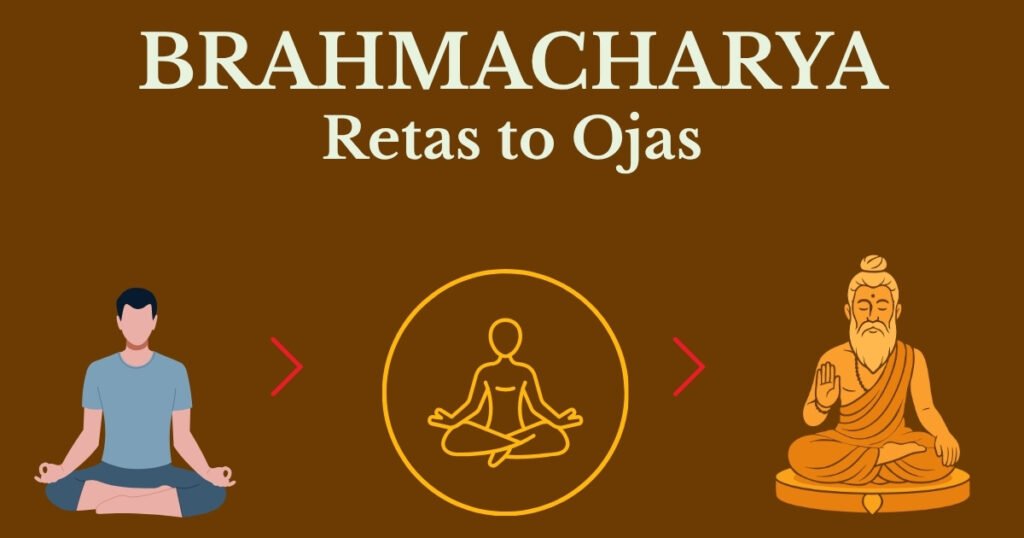
Brahmacharya holds a significant place in India’s spiritual traditions. But what does it actually mean?
In Patanjali’s Yoga Sutras, brahmacharya is one of the five yamas, the ethical disciplines that form the foundation of yoga. Patanjali places it alongside ahimsa, satya, asteya and aparigraha. In Sutra 2.38, he describes the result of establishing oneself in brahmacharya.
Traditional interpretations connect brahmacharya with sexual restraint, conservation of vital energy and the disciplined direction of one’s life towards spiritual growth. In renunciant traditions, it includes complete sexual abstinence.
However, practising brahmacharya and reaching a state of inner freedom from sexual desire are two different things.
You may decide to abstain from sexual activity. You may follow strict rules and control your behaviour. But the mind may continue to seek sexual pleasure. You may maintain your commitment while fighting the same inner battle every day.
This raises a deeper question. Can spiritual practice transform your relationship with desire so profoundly that brahmacharya no longer feels like a constant struggle?
To explore this possibility, we must understand why desire holds such power over the mind, why modern life makes this discipline difficult and what a sincere seeker can do to progress.
Why Is Brahmacharya So Difficult in the Modern World?
Look at the world around you. Open your phone, browse social media, watch a movie or scroll through advertisements. Sexual imagery appears everywhere. Digital platforms constantly compete for your attention and often use stimulating content to keep you engaged.
Repeated exposure can shape your thoughts, strengthen habitual patterns and make sexual stimulation an increasingly familiar part of daily life.
The challenge no longer comes only from biological desire. Your environment can continuously reinforce that desire through images, memories, fantasies and repeated exposure.
Even when you sincerely decide to practise brahmacharya, these patterns may continue to influence your mind.
You may begin with determination. You avoid sexual content, follow a strict routine and maintain your commitment for several weeks or months. Then your discipline weakens. Old habits return, and you find yourself back where you started.
This cycle can discourage even a sincere seeker.
The problem is not always a lack of determination. You may be trying to change a deeply established pattern without changing the environment, habits and mental attachments that sustain it.
Strict discipline can help. Reducing stimulation can help. A structured daily routine can help. But you also need to understand your mind and work towards a deeper change in your relationship with desire.
Brahmacharya demands more than the decision to abstain. It demands a sustained effort to change how you live, where you direct your attention and how you respond to your impulses.
Why Do Discipline and Spiritual Progress Need to Go Together?
Discipline helps you control your actions. Spiritual practice helps you examine the mind behind those actions.
You need both.
Suppose you remove every source of sexual stimulation from your surroundings. You may find it easier to maintain brahmacharya. But if your mind remains preoccupied with sexual pleasure, you may continue to struggle internally.
Now suppose you meditate regularly, study spiritual teachings and examine your attachments, but make no effort to change habits that repeatedly trigger sexual urges. Your environment may keep pulling your attention back towards the same patterns.
This is why discipline and inner development should support each other.
Start by bringing your daily life under greater control. Reduce unnecessary stimulation, organise your time and stop feeding habits that conflict with your commitment.
At the same time, examine your relationship with desire. Observe your thoughts. Understand what triggers your urges. Learn to experience an impulse without automatically following it.
Spiritual progress requires honesty. Do not convince yourself that you have transcended desire simply because you have stopped acting on it. Equally, do not assume that every sexual thought represents failure.
The real question is whether you are developing greater freedom over your attention and actions.
In the spiritual understanding of brahmacharya, the deeper aspiration goes beyond controlling the senses. It seeks a mind that no longer depends so heavily on external pleasure for its sense of fulfilment.
No routine can guarantee this transformation. You must practise, observe and understand your own experience.
Why Does a Sincere Seeker Need a Guru?
Spiritual books can explain the principles of brahmacharya. Meditation instructions can help you establish a practice. But applying these teachings to your own mind can raise difficult questions.
You may mistake suppression for detachment. You may become excessively rigid. You may interpret a temporary experience of peace as permanent spiritual progress. You may also struggle to recognise the habits and attachments that you cannot easily see in yourself.
An experienced and trustworthy guru can help you recognise these mistakes.
A genuine teacher can explain the scriptures, guide your practice and help you understand difficulties as they arise. They can challenge your assumptions and help you distinguish genuine progress from wishful thinking.
Finding such a guide, however, requires care.
Do not judge a guru by appearance, popularity or impressive speeches. Look at their conduct, integrity, consistency and treatment of their students. Be cautious of anyone who promises instant realisation, demands unquestioning obedience or uses spiritual authority to exploit people.
You should also understand that a guru cannot do your inner work for you. A teacher can provide direction, but you must practise sincerely and examine your own mind.
I believe this is one of the greatest challenges facing a person who wants to pursue brahmacharya deeply. Access to spiritual information has become easy. Finding an experienced guide who understands the path through personal practice and can guide others responsibly remains much harder.
If you cannot find such a teacher immediately, do not abandon your efforts. Begin with reliable scriptures, a consistent routine and honest self observation. Continue your search with patience and discernment.
How to Begin Practising Brahmacharya at Home
If you sincerely want to practise brahmacharya, start with your daily life. Do not wait for extraordinary spiritual experiences before making changes.
1. Establish a clear intention
First, understand why you want to practise brahmacharya.
Do you seek spiritual growth? Do you want greater mastery over your mind? Do you want to direct your time and energy towards a deeper purpose?
You need an honest answer.
If you adopt this discipline without understanding your reason, your motivation may weaken when desire becomes strong. A clear intention gives you something to return to when the practice becomes difficult.
Write down your reason and revisit it regularly. Let your commitment come from understanding rather than temporary enthusiasm.
2. Remove unnecessary digital stimulation
Examine how you use your phone and the internet.
Unfollow accounts that repeatedly trigger sexual thoughts. Stop consuming content that encourages compulsive stimulation. Avoid aimless scrolling, especially when you feel bored or restless.
Keep your phone away during meditation, meals and the first part of your morning. Set clear limits on entertainment and social media.
Do not underestimate the effect of repeated exposure. If you constantly feed your attention with stimulation, you make your practice harder than it needs to be.
Protect your attention. It is one of the most important resources in the practice of brahmacharya.
3. Give every part of your day a purpose
An unstructured day can leave you with long periods of boredom, distraction and unnecessary mental wandering.
Plan your day before it begins. Set fixed times for waking, meditation, work, exercise, study, meals and sleep.
Keep your routine realistic. You do not need an extreme schedule that exhausts you within a week. You need a structure you can maintain consistently.
When you finish one activity, know what you will do next. Reduce the time you spend drifting between your phone, entertainment and unproductive habits.
Discipline becomes easier when your daily actions support your intention.
4. Choose an outdoor sport or physical activity
Choose a sport you enjoy and practise it regularly. You could play badminton, run, swim, cycle or participate in another physical activity suited to your fitness.
Exercise gives your day structure and supports physical and mental well being. It can also provide a healthier response to stress and restlessness.
Do not treat exercise as a way to punish your body or eliminate every sexual urge. Its purpose is to help you maintain a healthy body, a balanced routine and a constructive direction for your energy.
5. Spend time outdoors in the morning
Begin your day with a walk in a park or another open space. Spend time in natural daylight and allow yourself to start the morning without immediately reaching for your phone.
You can combine this time with quiet reflection, prayer or meditation.
A calm morning routine can help you approach the day with greater attention and purpose. It also gives you an opportunity to establish your commitment before digital distractions take over.
Make this a regular habit rather than an occasional activity.
6. Examine your dependence on stimulants
Pay attention to how caffeine and other stimulating substances affect your sleep, restlessness and daily habits.
If you consume large amounts of coffee or tea and notice that they interfere with your sleep or make you feel unusually restless, reduce your intake gradually. Avoid alcohol if it weakens your judgement or leads you towards behaviour that conflicts with your commitment.
You do not need to assume that every cup of tea or coffee undermines brahmacharya. The important question is whether a particular habit supports your health, clarity and discipline.
Learn to recognise what your body needs and what has become an unnecessary dependency.
7. Keep your body healthy and your mind engaged
Maintain regular sleep, eat a balanced diet and exercise consistently. Take care of your physical health rather than treating the body as an obstacle to spiritual growth.
Give your mind meaningful work. Study a scripture, learn a skill, pursue your profession, serve others or develop an activity that requires sustained attention.
A healthy routine cannot guarantee spiritual realisation. But it can provide a stable foundation for your practice.
Do not spend the entire day thinking about what you must avoid. Give yourself something worthwhile to work towards.
8. Practise meditation and self observation every day
Set aside time for meditation. Begin with a simple practice of observing your breath. When thoughts arise, notice them and return your attention to the breath.
When sexual thoughts appear, do not panic or fight them aggressively. Recognise them without automatically following them.
Ask yourself what preceded the thought. Were you bored, stressed, lonely or exposed to stimulating content? Understanding the pattern can help you respond more consciously next time.
Keep your observations honest. Notice your progress and your difficulties without exaggerating either.
Over time, this practice may help you develop greater awareness and control over your responses. Continue learning from reliable spiritual teachings, and seek guidance when you can find a trustworthy teacher.
The goal is not to force your mind into silence. It is to understand it more clearly and stop allowing every impulse to dictate your behaviour.
The Deeper Goal: From Restraint to Inner Freedom
Brahmacharya begins with a conscious commitment. You establish discipline, change your habits and learn to manage your impulses.
But the deeper spiritual aspiration goes further.
Can you reach a state in which sexual desire no longer dominates your attention? Can you experience inner contentment without constantly seeking external pleasure? Can brahmacharya become a natural expression of your understanding rather than a rule you must defend against yourself every day?
Indian spiritual traditions offer different ways of understanding this possibility. They place importance on self discipline, mastery of the senses, non attachment and spiritual realisation.
We should not promise that a particular routine will produce a permanent state free from sexual desire. Spiritual progress varies from person to person. A sincere practitioner must approach the journey with patience, discernment and honesty.
But you can begin today.
Protect your attention. Structure your day. Care for your body. Practise meditation. Study the scriptures. Examine your desires without fear. Seek a trustworthy guru and remain willing to learn.
Do not judge your entire journey by one difficult day. Look at the direction in which you are moving.
Brahmacharya is not just about what you give up. It is about what you seek to develop within yourself.
Let discipline give your practice a foundation. Let spiritual inquiry deepen your understanding. And let your commitment grow from a clear intention to live with greater awareness, self mastery and inner freedom.